

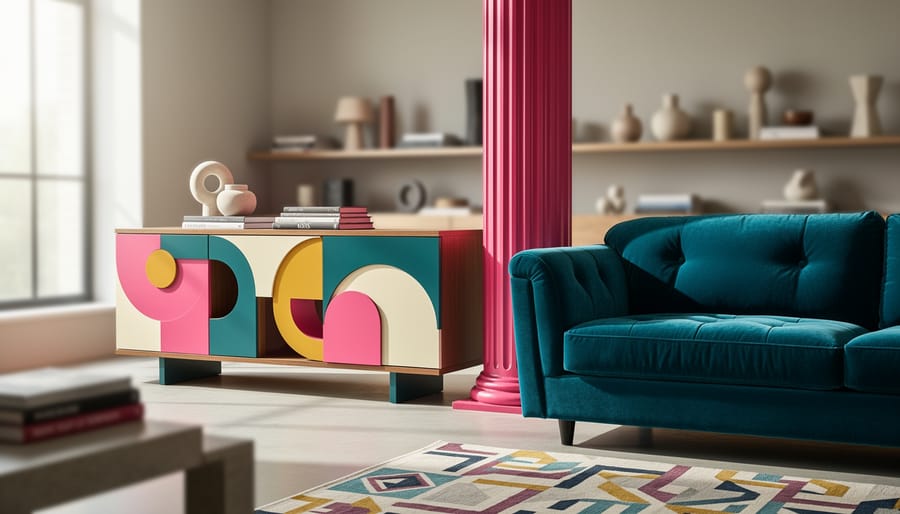
Postmodern interior design is a bold, eclectic style that celebrates contradiction, mixing historical references with contemporary materials, playful color with geometric precision, and high culture with everyday objects. Unlike minimalism’s restraint, postmodern spaces embrace personality through unexpected combinations: a Memphis-style geometric credenza alongside a plush velvet sofa, or a classical column detail reimagined in bright pink lacquer. The style emerged in the 1980s as a direct rebellion against modernism’s “form follows function” doctrine, and it’s experiencing a resurgence right now because more people are rejecting the beige-box sameness of the past decade.
Why is postmodern design gaining momentum in 2026? After years of minimalist interiors dominating social media and design magazines, many of us are craving spaces that actually reflect who we are. The mental health conversation has shifted too, with growing awareness that our environments profoundly affect our emotional well-being. Creating a home filled with colors, textures, and objects that spark joy isn’t frivolous. It’s a form of self-expression that can boost mood and reduce stress, much like art-making itself. When you choose a scalloped side table or a lounge chair in jewel-toned velvet, you’re not just decorating. You’re building an environment that honors your individuality rather than erasing it.
This guide will walk you through postmodern design’s core principles, show you accessible ways to bring the style into your home with real pricing examples, and explain how these vibrant, personalized spaces support your mental health.
Why Postmodern Design Is Emerging Now
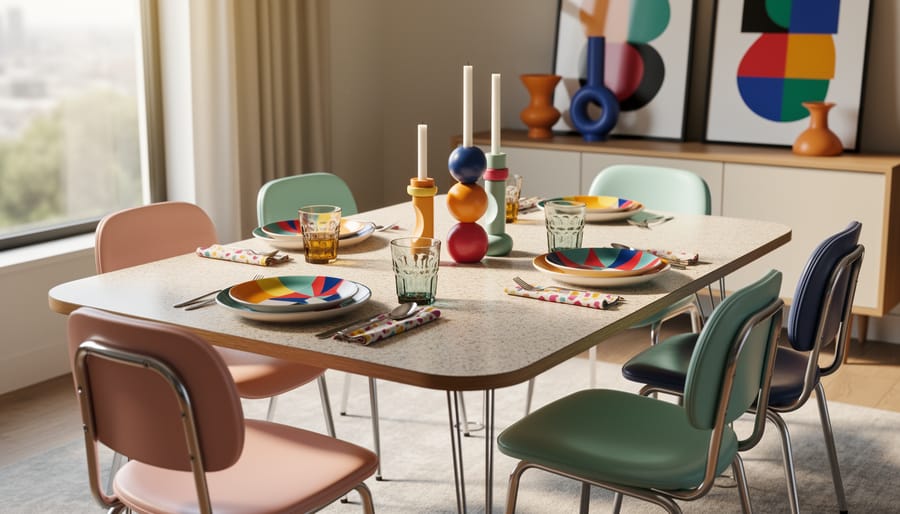
Postmodern interior design’s 2026 resurgence stems from several converging cultural shifts. After a decade of minimalist dominance, many people feel exhausted by stark, monochrome spaces that prioritize function over personality. The stark white walls and neutral palettes that once promised calm now feel sterile and emotionally flat. As home environments took center stage during remote work expansions, the desire for spaces that reflect individual identity rather than design formulas intensified.
Nostalgia plays a significant role. The ’70s and ’80s aesthetics that define postmodern design resonate with younger buyers discovering these eras for the first time and older generations revisiting formative influences. Industry forecasters recognize this momentum: Moe’s Home 2026 Design Trend forecast includes dining room pieces whose straight, rounded table legs nod to ’70s Italian and postmodern forms, signaling mainstream adoption beyond niche collectors.
Crucially, the connection between environment and mental health has shifted from abstract theory to practical priority. Research in environmental psychology shows that spaces allowing self-expression reduce stress and improve mood. Postmodern design’s embrace of bold color, playful forms, and eclectic mixing gives people permission to create homes that feel emotionally authentic rather than aesthetically correct. This isn’t frivolous decoration, it’s recognizing that surrounding yourself with elements that spark joy and reflect your personality supports emotional resilience.
The style’s rule-breaking nature appeals to a generation skeptical of prescribed solutions. Instead of following rigid design systems, postmodern interiors encourage experimentation, layering, and personal curation. That freedom to mix patterns, combine unexpected materials, and display quirky objects without apology transforms decorating from a stressful quest for perfection into a therapeutic act of self-discovery.
Core Principles of Postmodern Interior Design
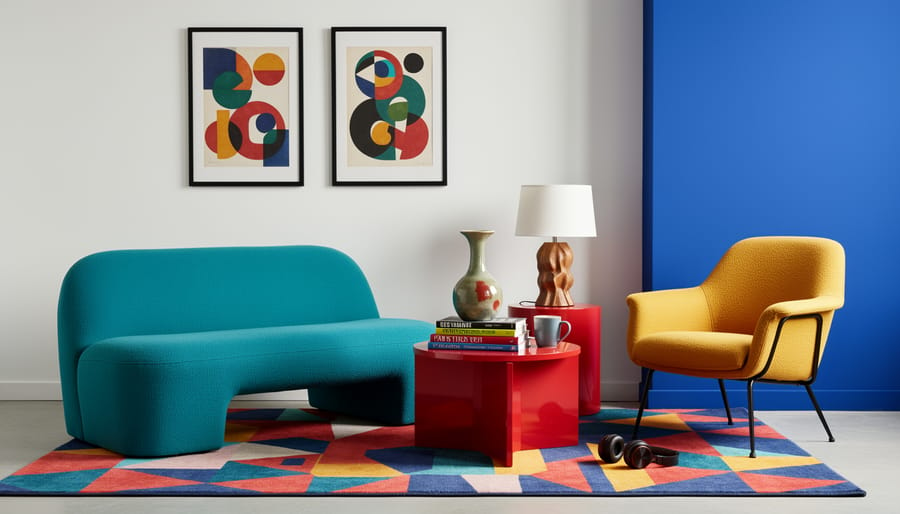
Postmodern interior design refuses to follow the rules that governed modernism for decades. Where modernism demanded “form follows function” and stripped away ornament, postmodernism celebrates contradiction, humor, and visual surprise. It’s a style built on intentional rule-breaking, and that freedom is precisely what makes these spaces feel alive and personally meaningful.
Bold color contrasts anchor the postmodern palette. You’ll see jewel tones like emerald green paired with hot pink, or mustard yellow alongside cobalt blue. These aren’t timid accent walls, they’re deliberate clashes that create energy and visual tension. The approach rejects the safe, neutral schemes that dominated the last decade, inviting you to express mood and personality through color choices that feel daring rather than coordinated.
Geometric and asymmetric forms define postmodern furniture and architecture. Think chairs with oversized circular backs, tables with triangular legs, or mirrors shaped like sunbursts. Asymmetry appears intentional, not accidental: a bookshelf might have shelves at irregular intervals, or a lamp might balance a heavy base with a tilted shade. Moe’s Home 2026 Design Trend forecast highlights dining pieces with straight, rounded table legs that nod to ’70s Italian and postmodern forms, showing how these shapes are cycling back into mainstream collections.
Playful ornamentation reclaims what modernism discarded. Postmodern spaces feature pattern-on-pattern layering, unexpected decorative elements like squiggle motifs or Memphis Group-inspired graphics, and furniture that serves as sculpture. A side table isn’t just functional, it might have scalloped edges or legs in contrasting colors that make it a conversation piece.
Eclectic material mixing is essential. You’ll see laminate next to velvet, brushed metal paired with frosted glass, terrazzo alongside lacquered wood. The Oren Velvet Lounge Chair at $699 demonstrates this perfectly: plush fabric meets bold structural lines, creating tactile variety that invites touch and engagement.
This intentional collision of elements does more than look interesting. It creates environments that reject conformity and celebrate individuality, giving you permission to surround yourself with objects and colors that genuinely resonate. When your space reflects your authentic preferences rather than design dogma, it becomes a setting for self-expression and creative thinking, qualities that support emotional well-being and personal growth.
How Postmodern Spaces Support Mental Health
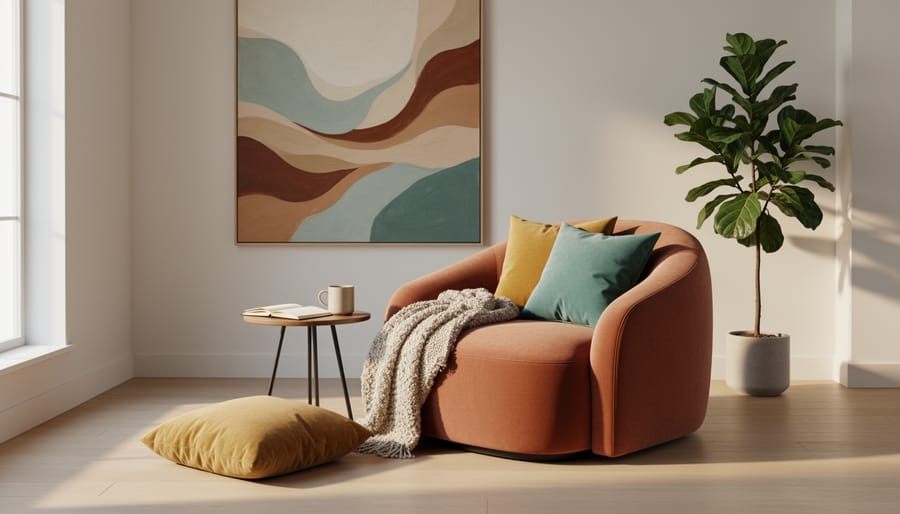
Postmodern interiors do more than catch the eye. They actively shape how we feel in our homes. Vibrant color contrasts and unexpected shapes stimulate the brain in ways that flat, neutral palettes don’t, triggering dopamine release and lifting mood. When you walk into a room with a bold teal sofa against terracotta walls, your nervous system responds to that visual novelty, breaking the monotony that can feed low-level anxiety. This isn’t just aesthetics; it’s environmental psychology at work.
Personalized spaces also strengthen our sense of identity and control, both crucial for emotional resilience. Unlike cookie-cutter minimalism that can feel sterile or anonymous, postmodern design invites you to mix what you love: a vintage lamp, a geometric rug, a quirky sculpture. That freedom to curate your surroundings mirrors the self-expression central to art therapy mindfulness practices, where exploring creative choices builds self-awareness and agency. Rooms that reflect who you are, rather than who a catalog tells you to be, become anchors during stressful times. They remind you of your preferences, your history, your right to take up space in ways that feel authentic.
The playful, rule-breaking nature of postmodern decor also reduces mental rigidity. Embracing asymmetry or clashing patterns challenges the perfectionism that fuels stress. It normalizes experimentation and imperfection, qualities that support mental flexibility and growth. For people working through transitions or seeking ways to de-stress at home a space that celebrates individuality over convention offers tangible comfort. Even those facing homesickness coping challenges find that surrounding themselves with personally meaningful objects and bold colors creates a cocoon of familiarity and safety. In this way, postmodern design becomes a form of environmental self-care, a daily practice of choosing joy and authenticity over conformity.
Accessible Ways to Bring Postmodern Design Into Your Space
You don’t need a complete overhaul to embrace postmodern interior design. Start with one or two statement pieces that introduce color, geometry, or unexpected forms, then layer in smaller accents as your confidence and budget allow.
The easiest entry points are furniture pieces that punch above their weight visually. A velvet lounge chair in a saturated hue, like the Oren Velvet Lounge Chair at $699, becomes an instant focal point that signals playfulness without requiring you to repaint or renovate. Side tables with sculptural shapes offer similar impact at lower price points, the Scallop Side Table, for example, retails at $548 but often appears on sale for $438, giving you that signature postmodern curve without a four-figure commitment. Even larger investments like the Classic Bed at $1,995 anchor a bedroom with clean-lined boldness that works whether you layer in maximalist textiles or keep bedding simple.
| Design Element | Budget-Friendly Option | Where to Find It |
|---|---|---|
| Statement seating | Velvet accent chair in bold color | Oren Velvet Lounge Chair, $699 |
| Sculptural side table | Geometric or scalloped form | Scallop Side Table, $438 (sale price) |
| Color blocking | DIY painted furniture or large art prints | Thrift stores, Etsy, your own bedroom dresser |
| Asymmetric accessories | Mismatched vases, abstract candle holders | HomeGoods, local vintage shops, estate sales |
Thrift stores and vintage markets are treasure troves for postmodern finds. Look for ’80s lamps with Memphis-style geometric bases, mirrored trays, chunky ceramic vases, or framed abstract prints. These pieces often cost under $50 and deliver immediate personality. You can also DIY postmodern elements by painting an old dresser in contrasting blocks of pink and teal, swapping out standard cabinet knobs for asymmetric ceramic pulls, or framing bold wrapping paper as affordable wall art.
Renters have just as much flexibility. Removable wallpaper in geometric patterns, freestanding mirrors with sculptural frames, and textile swaps, think a squiggle-patterned throw blanket or color-blocked cushions, transform a space without touching walls or floors. Even switching out lampshades for ones in saturated colors or unexpected shapes shifts the mood instantly.
The key is to start small and add elements that genuinely resonate with you. Postmodern design rewards personal curation over matching sets, so mix a vintage find with a contemporary piece and a DIY project. This approach keeps costs manageable while building a space that feels authentically yours, layer by layer.
Common Questions About Postmodern Interior Design
How does postmodern interior design differ from mid-century modern?
Mid-century modern emphasizes clean lines, organic forms, and functional simplicity, while postmodern design intentionally breaks those rules with bold geometric shapes, playful ornamentation, and eclectic material combinations. Postmodern spaces embrace asymmetry and contrast where mid-century prefers balance and restraint.
Can postmodern design work in small spaces?
Absolutely. Focus on one or two statement pieces rather than filling every surface, a geometric mirror, a velvet accent chair in an unexpected color, or a playful side table can introduce postmodern energy without overwhelming a compact room. Small spaces benefit from the style’s emphasis on individuality through selective, meaningful additions.
Is postmodern interior design suitable for renters?
Yes, because the style thrives on furniture and accessories rather than permanent changes. Removable elements like bold throw pillows, geometric rugs, colorful lighting fixtures, and sculptural decor let you experiment freely without altering walls or built-ins, making postmodern design particularly renter-friendly.
How do I avoid overwhelming a room with postmodern elements?
Start with a neutral backdrop and add postmodern pieces gradually, balancing bold statements with breathing room. Choose one focal point per area, such as an Oren Velvet Lounge Chair at $699 as your living room anchor, and layer in smaller accents that echo its colors or forms without competing for attention.
What’s the difference between postmodern and maximalist design?
Maximalism celebrates abundance and layering across all surfaces, while postmodern design uses strategic rule-breaking and intentional contrasts. Postmodern spaces can feel sparse or crowded depending on your choices, but they’re unified by playful geometry and unexpected material pairings rather than sheer volume of objects.
These questions come up often when people first explore postmodern interior design, especially if they’re used to more restrained contemporary styles or want to compare modern styles side by side. The answers highlight what makes postmodern design accessible: you don’t need a big budget, a large home, or permission to modify your space. You just need willingness to experiment with pieces that feel personally meaningful and visually interesting, even if they don’t follow conventional design logic. That freedom is what makes the style both creatively liberating and emotionally supportive.
Postmodern interior design offers more than visual drama, it creates spaces that reflect who you are and how you want to feel. By embracing color, playful forms, and rule-breaking eclecticism, you build an environment that supports your mental well-being through authenticity and self-expression. You don’t need a designer budget or a complete overhaul. Start small: a geometric mirror, a bold velvet chair, a quirky thrift-store find that makes you smile. Each piece that resonates with you personally adds therapeutic value, turning your home into a space that nurtures rather than constrains.
This shift toward individuality in design mirrors a broader cultural recognition that personalized environments support emotional health. If you’re drawn to deeper exploration of self-expression as a healing practice, art therapy offers structured ways to process emotions and discover new perspectives through creative work. Your space, like your inner life, deserves to be uniquely yours, colorful, imperfect, and joyfully human.
